
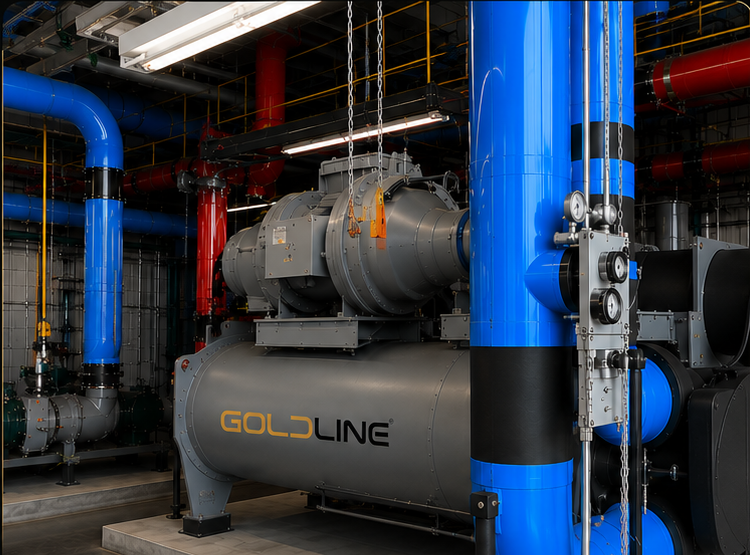
The quiet months are when higher-education facilities teams set up the entire academic year. Here is how to use the summer window — and how Goldline HVAC keeps campuses comfortable at full capacity.
Every campus has two calendars. There is the one students know, built around move-in day, lectures and exams. And there is the one facilities teams live by, where the most important work happens in the weeks when the buildings are nearly empty.
By the time students walk back through the doors, the decisions that shape their comfort, their safety and the institution’s operating costs have already been made. Campus readiness does not start in September. It starts now.
The summer window
During term, a campus HVAC system runs under constant demand and near-zero tolerance for downtime. Lecture halls, laboratories, libraries and residences all need to be conditioned at once, often through the hottest part of the year. There is rarely a good moment to take a chiller offline or open up a plant room once the semester is underway.
That makes summer the one dependable window to get ahead of the load — to service and optimize plant, confirm that capacity matches the coming occupancy, and take running costs out of the system before they compound over an entire academic year. Teams that treat these months as preparation, rather than a pause, are the ones that avoid emergency call-outs when the campus is full.
Aging or conventionally specified systems make that window harder to use. They drift out of tune, lose efficiency at peak conditions, and offer little visibility into how they are actually performing. The goal of a strong summer program is to close those gaps before they become term-time problems.
What to prioritize this summer
Facilities teams cover a lot of ground between May and August. Three priorities consistently return the most value.
- Plant readiness and HVAC system optimization. Service, rebalance and tune equipment while it is offline, so it is verified and ready before the load arrives — not diagnosed after it fails.
- Building automation (BAS) visibility and control. Real-time insight across campus systems turns a collection of independent units into one manageable estate. When you can see performance, you can improve it.
- Preparing for full occupancy. Size and stress-test capacity against the peak headcount and peak heat you will actually face, so the first week of term is a non-event rather than a scramble.
None of these are dramatic. All of them are the difference between a comfortable return and a reactive one.
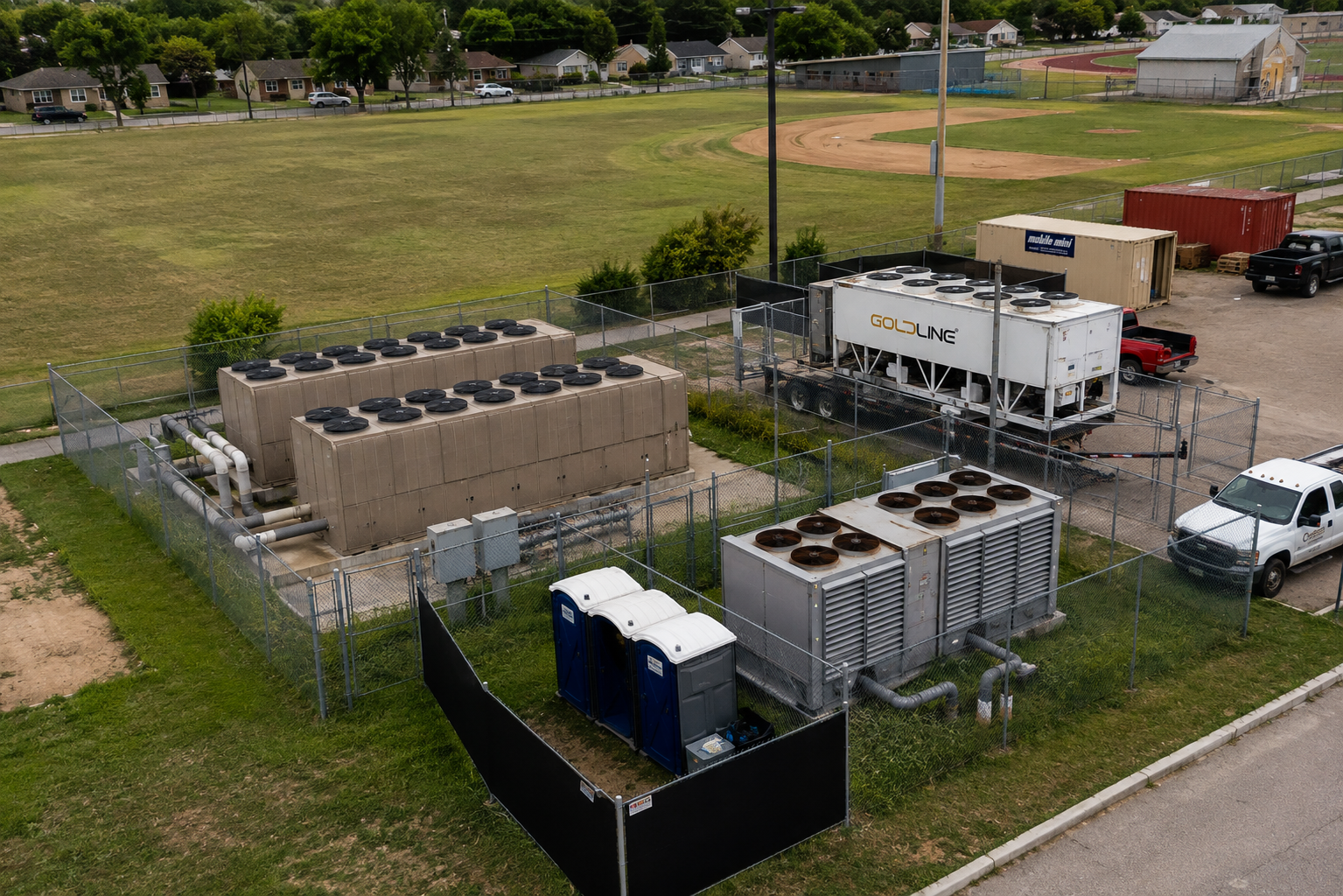
Inside a central campus energy plant
Larger institutions increasingly centralize cooling and heating into a single energy plant that serves the whole campus. Done well, this is one of the most effective ways to support growth: capacity can be added as the campus expands, redundancy protects critical buildings, and a centralized system is far easier to monitor and optimize than dozens of scattered units.
A leading-edge central energy plant does more than keep buildings cool. It underpins campus growth, improves operational resilience, and advances sustainability targets by running efficiently under real conditions rather than ideal ones. It is infrastructure that students never see and never have to think about — which is exactly the point.
Why Goldline for campuses
Goldline builds HVAC and energy systems for the conditions education facilities actually operate in, not the ones on a spec sheet. Across our range — Solar AC Hybrid systems that reduce daytime cooling load and running cost, inverter air conditioning uprated for high-ambient environments, and green-energy inverters that keep power steady behind critical plant — the priorities are consistent:
- High efficiency. Lower operating costs when it matters most, so budgets stretch further across the year.
- Reliable performance. Consistent comfort for students and staff, engineered to hold output at peak rather than fade under it.
- Built for campuses. Equipment designed for continuous duty and the demands of education environments, backed by catalog documentation and specification support that stands up to procurement review.
Every product carries the same engineering standards, and every installation is supported by a partner who understands what a campus needs to stay open.
Ready for the return
The work that decides how a campus feels in September is happening right now, in plant rooms and energy centers while the halls are quiet. Use the summer window well, and full occupancy arrives as a plan you executed rather than a problem you inherited.
Let’s build a more efficient, resilient and sustainable campus together.
Our Technology. Your Innovation.